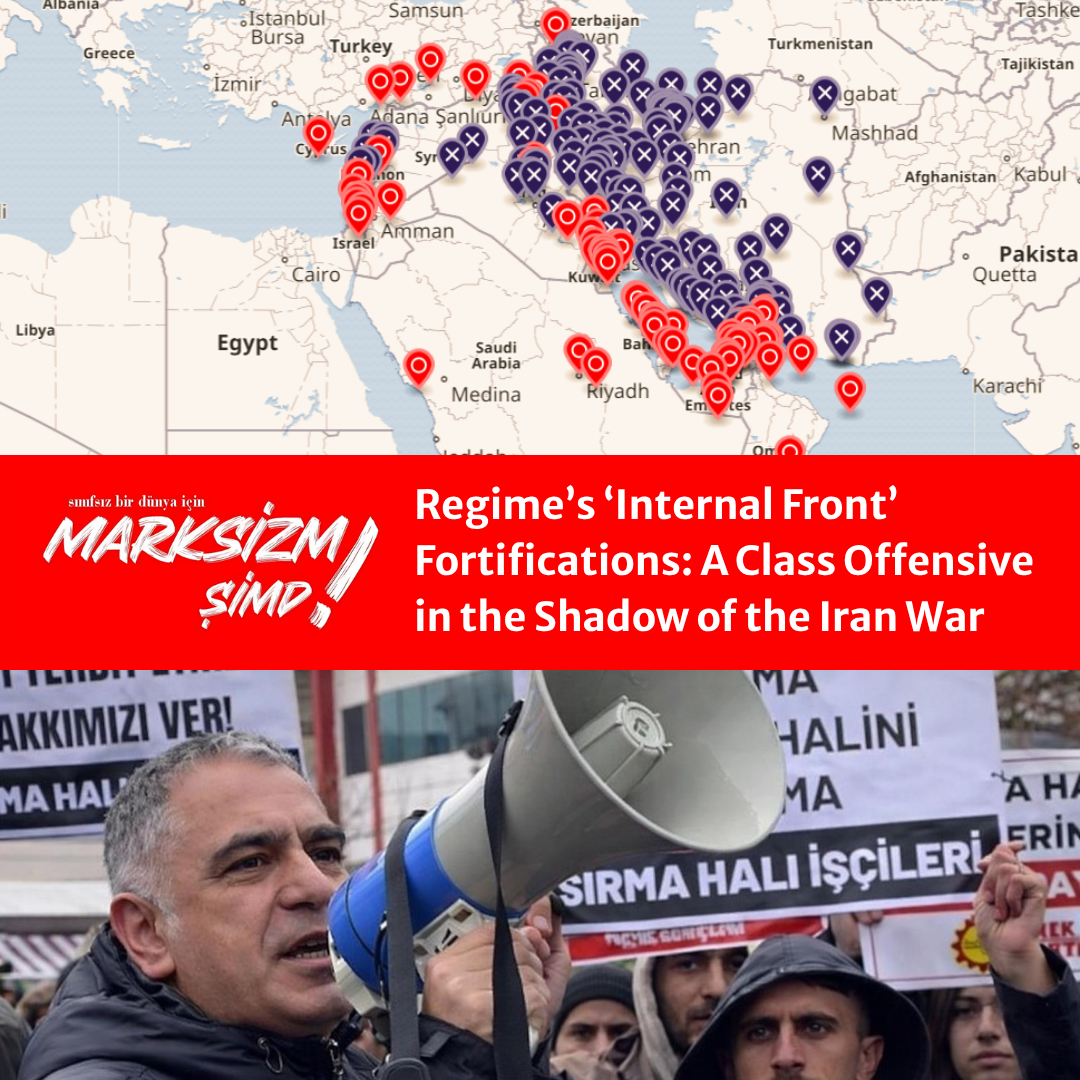
Under the pretext of the Iran war, the regime aligns itself with imperialist balances while consolidating the “home front” domestically: on one hand, it deepens its assault on the working class; on the other, it suffocates all avenues of social opposition. The way out lies not in waiting for the ballot box, but in building an independent class front.
Marksizm Şimdi! Editorial Board / 23 March 2026
The escalating tension centred on Iran has, as of March 2026, moved beyond a conventional military conflict to evolve into a global trade and energy war. Whilst US imperialism and Zionism strive to overcome the logistical bottleneck in the Strait of Hormuz, Iran’s demand to conduct oil trade in Yuan and China’s offer of “energy patronage” towards Taiwan are intensifying the cracks in the unipolar world order.
Iran’s responses to Israel and the US’s targeted operations, delivered through the “axis of resistance” (Hezbollah, the Houthis, Shia militias), have now taken the form of a regional war of attrition. The internal political crisis within Israel and the survival of the Netanyahu regime are driving a tendency to keep the conflict constantly simmering. Iran, rather than risking the regime by entering into direct war, is forcing the US to the negotiating table by threatening regional logistics routes (the Red Sea, the Strait of Hormuz) and energy corridors.
Doha and Riyadh: NATO’s Loyal Outpost
The Gulf Cooperation Council (GCC) meetings held back-to-back in Doha and Riyadh in March 2026, along with conferences attended by 12 countries, once again laid bare the true face of Turkish diplomacy. Hakan Fidan did not hesitate to sign the joint statement, which, despite a few feeble condemnations of Israel’s expansionism added at Turkey’s insistence, primarily targeted Iran. Whilst the names of the US and Israel were not mentioned, the call for “Iran not to use its military capabilities as a threat” clarifies Ankara’s stance.
Ankara’s capitalist rationality codes not Israel’s presence in the region, but Iran’s “game-changing” moves as the primary threat. The Bonapartist regime, confined in Syria to merely blocking the Kurdish corridor, is condemned to a similar “buffer” role in the Iran-Israel tension. This predicament—caught between protecting Iran’s gas flows (its economic lifeline) and serving as the West’s forward outpost (Kürecik, etc.)—highlights the vast gulf between the appetite for “sub-imperialist expansionism” and real power.
The scenario in which Turkey would be fully integrated into Europe and NATO’s defence shield in exchange for concessions such as visa-free travel has now moved beyond mere rumour. The statement by AP Rapporteur Nacho Sanchez Amor in early March – “Six criteria remain for visa liberalisation, but officials are indifferent” – coupled with Turkey’s participation in NATO’s Steadfast Dart-2026 exercise with 2,000 troops, proves that the process is not about “democratic reform” but a “security bargain”. The promise of a more active role in Europe’s defence architecture (such as the procurement of Eurofighters or missile defence systems) is being traded off against Turkish citizens’ freedom of travel. This is the regime’s second major bargaining chip and leverage following the refugee crisis.
The current situation inevitably intertwines the struggle against NATO with the struggle against the regime. The mass mobilisation to be organised against the NATO summit in Istanbul this April is critical in this regard. A united front of all anti-NATO forces will make its voice heard not only locally but on a global scale. This process will also strip away the ‘anti-imperialist’ facade of social democrats and political Islamists.
The Regime’s Big Stick: A Warning to Activist Circles in the Person of Mehmet Türkmen
Whilst Ankara poses as a “rational ally” to the imperialist hierarchy abroad, it markets this relationship of dependency to the masses at home under the guise of “survival”. The most tangible consequence of this massive geopolitical clamour is the opportunity for attack the regime has found to consolidate its “internal front”. The Palace is using the external tension as a lever to forcibly suppress social opposition at home. If the working class and the forces of the labouring people cannot disrupt this game, the Bonapartist regime appears set to emerge from this process having cemented its domination.
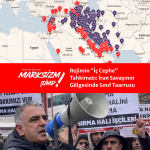
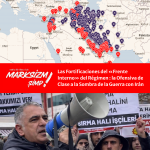
Whilst the mullah regime in Iran uses the rhetoric of an “external threat” to brand workers’ strikes as “treason”, the regime in Turkey is simultaneously wielding the “internal front” stick. The arrest on 16 March of Mehmet Türkmen, General Secretary of BİRTEK-SEN (United Textile, Leather and Weaving Workers’ Union), is the starkest manifestation of this strategy. Türkmen, who was sent behind bars on charges of “spreading misleading information to the public” for stating during the Sırma Halı workers’ resistance against destitution that “Workers’ hands and arms are being severed, not a single boss is testifying”, Türkmen was sent behind bars on the charge of “spreading misleading information to the public”. In reality, he is a victim of the Palace’s promise to Gulf monarchies and Western capital of a “quiet and thornless labour pool”.
Through Mehmet Türkmen, all militant sections of the working class are being threatened; ahead of the upcoming NATO protests and May Day, the vanguard cadres are being terrorised. Whilst attempts are being made to halt the spread of resistance and strikes akin to those at Migros, the aim is to sever the independent and resilient vein of the working class. Those who remain idle whilst textile factories close one by one and wretched working conditions are imposed in those that remain; yet when workers seek their rights, they deploy the judicial machinery in its harshest form.
Mehmet Türkmen is the spark that signals a new class-based uprising against the current bureaucratic trade unionism. The regime and capital are well aware of this threat. Angry workers have had enough of the trade union bureaucracy’s deceit, its structures that are even more cumbersome than the state apparatus, its corruption, and its avoidance of struggle. The regime’s stick, which does not want control to slip from its grasp, is cracking down precisely on these militant workers. Let us also note in history as a mark of shame that none of the relatively large confederations or trade unions have demanded Mehmet Türkmen’s release in a loud voice.
Mehmet Türkmen, Limter-İş executives Kanber Saygılı, İleri Devrim Yurtsever, Deniz Bakır and all other political prisoners must be released immediately. Knowing that the real threat lies in the mass mobilisation of the working class, the regime is attempting to bring the arena of class struggle under its control for the sake of the bosses’ profits and its own survival.
On the First Anniversary of the 19 March Judicial Coup: The Limits of the CHP and the Way Forward
The Palace has turned the drums of war and the risk of crisis in the region into a lever to bring the opposition into line under the banner of an ‘internal front’. Whilst the CHP (Republican People’s Party) hesitates to step outside the boundaries of the “internal front” drawn by the regime, every legitimate response by the socialist movement to the crisis is met with the labels of “separatism” or “chaos”. The threat of violence and arrest aims to paralyse every vein of social opposition.
Looking at the protests marking the first anniversary of 19 March, the decline in morale, despite the numerical size of the crowds, signals a clear political retreat. The CHP’s restriction of the struggle to mere rallies and the electoral calendar not only makes the regime’s task easier but also renders militant sections of society and the youth passive. Although broad sections of society still fill the squares, this dynamism is being kept under control by the CHP and confined to the playing field drawn by the regime. There is as yet no revolutionary political line capable of uniting the class movement with the struggle for democratic transformation against the regime. Given that the 2028 elections are expected to take place under far more undemocratic conditions, it is abundantly clear that the real way out lies not in the ballot box but in mass mobilisation.
The Taksim Call and the United Front of the Working Class
In this climate of retreat, the Turkish Workers’ Party’s (TİP) call for 1 May in the banned Taksim Square is undoubtedly significant in terms of pushing back against the regime and mobilising the vanguard sections. This bold move will have an encouraging effect on socialists and certain sections of the working class. However, a scenario in which trade unions and broad working-class masses fail to respond strongly to this call, and the mass movement becomes confined to a narrow space once again, could also carry the risk of rendering the working class’s fundamental demands invisible.
The regime’s dominance can only be broken through the united struggle of the working class, the oppressed sections of society and the youth. Such unity has not yet been fully achieved within the class movement. The blending of economic demands with democratic rights in the May Day squares is, in this respect, of vital importance. The lack of enthusiasm at CHP rallies proves that the opposition within the system has no fundamental objection to the machinery of exploitation, but merely awaits a ‘change of leadership’. Yet we do not need a change of leadership, but an independent class front.
Only mass struggles can shake the regime in the run-up to 1 May. Let us take to the streets to demonstrate our unity and strength; let us raise the voice of the working class against exploitation, repression and the lies of the ‘internal front’!
Marksizm Şimdi! Editorial Board